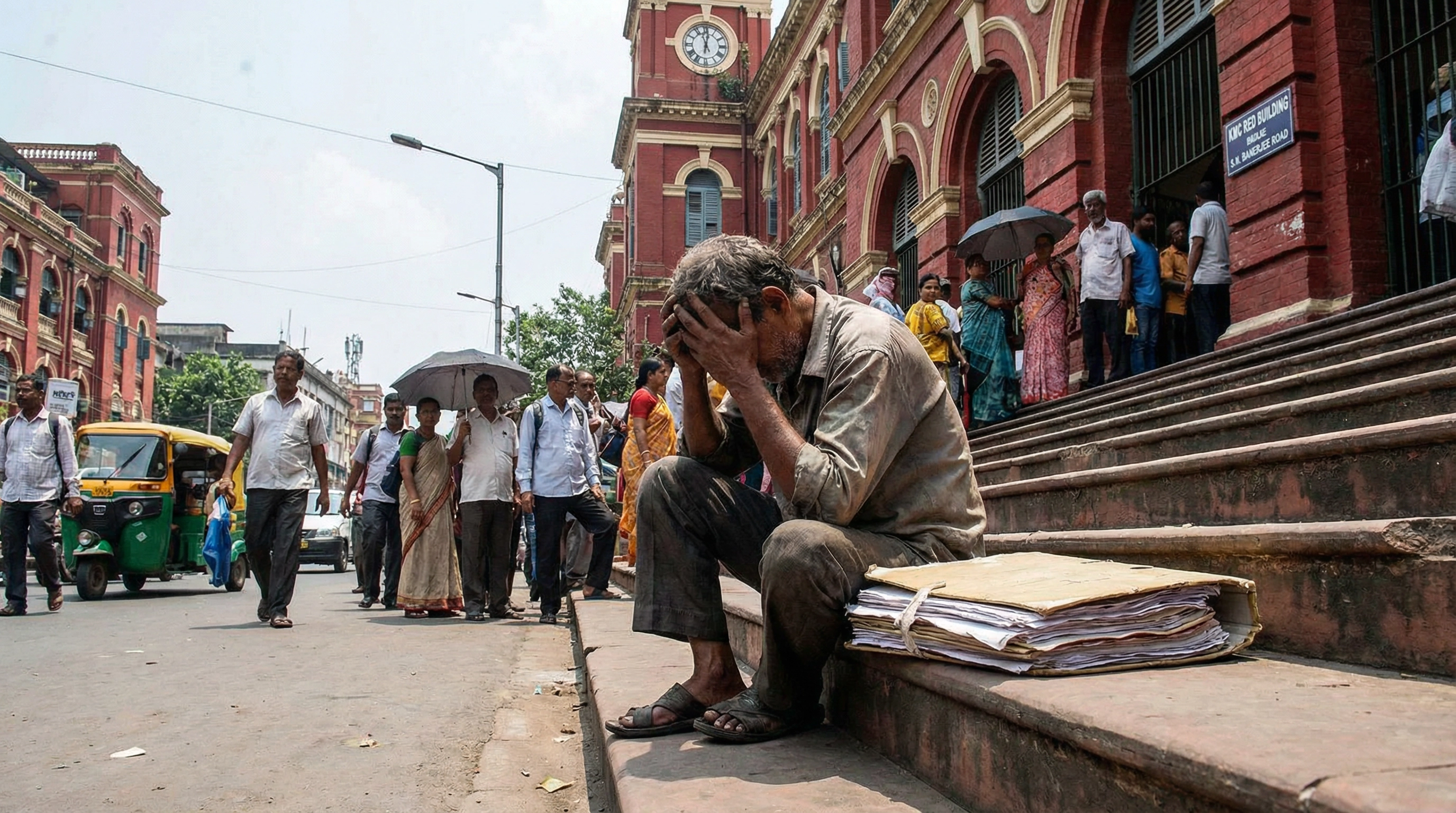
A 60-year-old grandmother stands in the heat of S.N. Banerjee Road because a ledger from 1964 wasn't scanned correctly. A father pays ₹500 for a certificate proving the Corporation lost his records. This is the Headache Tax.
The Silent Question in the Queue
In the humid corridors of the KMC Red Building, there is a silent question etched on the faces of the crowd: Why is this my problem?
If the government wants to digitise India, why must a 60-year-old grandmother stand in the heat of S.N. Banerjee Road because a ledger from 1964 wasn't scanned correctly? Why must a father pay ₹500 for a Non-Availability Certificate (NABC) just to prove that the Corporation lost his records?
This isn't just a bureaucratic delay. It is a "Headache Tax" — a penalty of time, health, and money imposed on the innocent.
Is This Legal? The Constitutional Question
Under Article 21 of the Constitution of India, every citizen has the Right to Life and Personal Liberty. The Supreme Court has interpreted this broadly to include the right to a dignified existence and access to basic government services. Legal scholars argue that a system that forces citizens to pay fees and spend weeks navigating administrative failures — for records the government itself failed to maintain — is a violation of this right.
In 2025, the Calcutta High Court took note of the KMC's digitisation backlog and directed the Corporation to expedite the uploading of legacy records. The direction has been partially implemented. The backlog remains enormous.
The Real Cost of the Headache Tax
Let us be precise about what this tax actually costs an ordinary Kolkata family:
Time: An average of 3–6 visits to KMC offices, each requiring half a day. That is 15–30 hours of lost working time for a family that cannot afford it.
Money: NABC fee (₹500), affidavit notarisation (₹200–500), court filing fee (₹1,000–2,000 for a Magistrate's order), document attestation, and transport. A total of ₹3,000–8,000 for a process that should be free.
Health: Standing in Kolkata's summer heat for hours. We have documented cases of elderly applicants fainting in the queue.
The Professional Alternative
You cannot eliminate the Headache Tax entirely — the fees are statutory. But you can eliminate the time, the confusion, and the repeated failed visits. Khan Consultants handles the entire process on your behalf. You pay us once. We absorb the headache so you don't have to.
WhatsApp us your situation. We'll give you a clear, honest assessment within 24 hours.
WhatsApp Khan Consultants →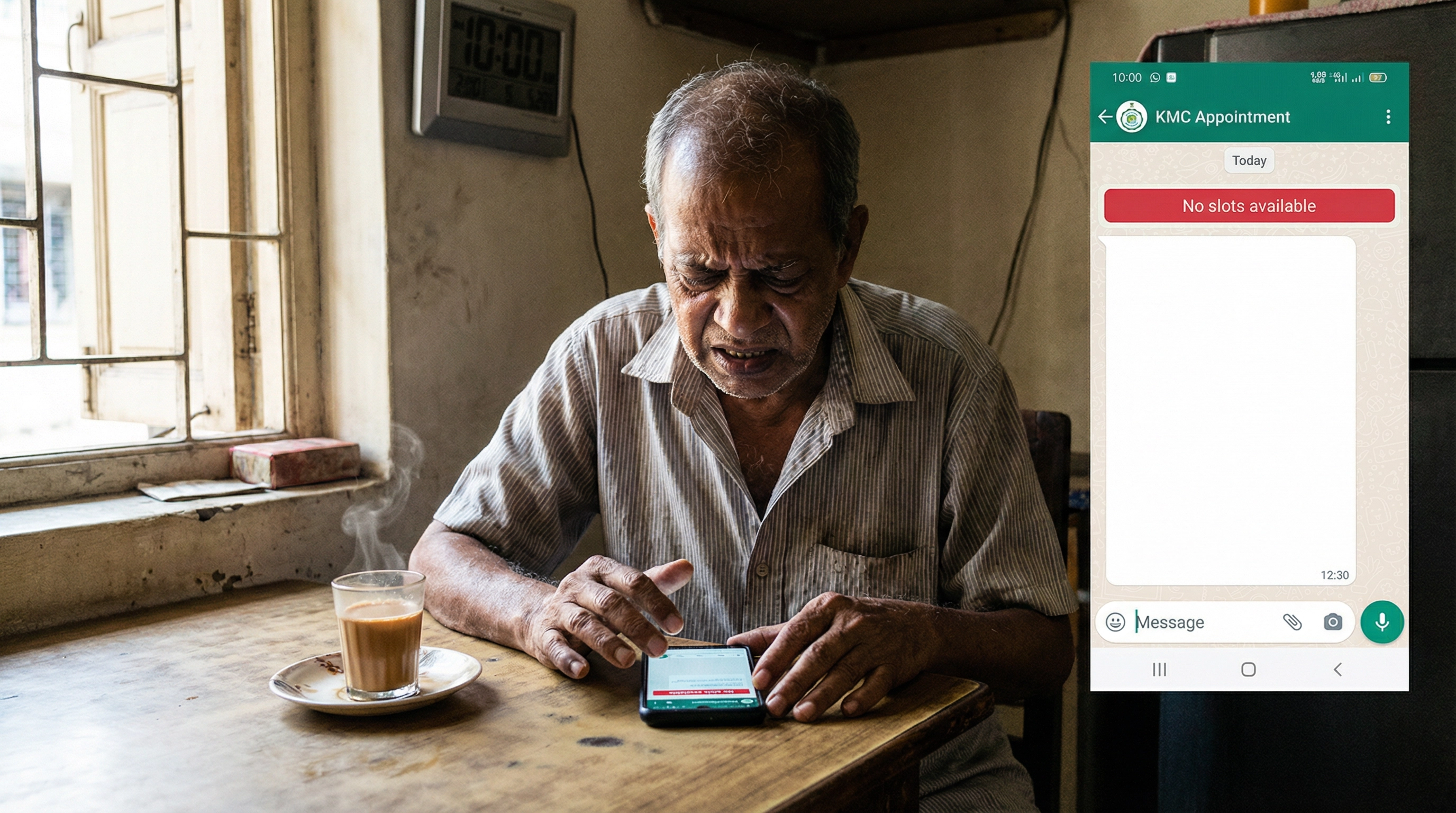

We use cookies to improve your experience, analyse traffic, and personalise content. We are registered with the ICO (Ref: C1893446) and handle all data in accordance with UK GDPR and the Data Protection Act 2018.
Khan Consultants · ICO Registered C1893446 · 26/1 Rafi Ahmed Kidwai Road, Kolkata 700016 · Privacy Policy · Terms